Shipping is not the final step after production. It should be planned before the purchase order is confirmed, because packing format, package dimensions, container choice, delivery term and destination access can all change the real landed cost.
Kitchen cabinets are a useful example: they are bulky, include fragile finished surfaces and hardware, and may contain hundreds of packages that must arrive in the correct installation sequence. The same workflow also applies to wardrobes, vanities and other project furniture.
The five sections below show what a buyer should confirm with a Chinese supplier and freight forwarder before shipment.
1. Goods packaging
Confirm four things before the factory starts packing: packing method, packing materials, pallet choice, and labels/shipping marks. These decisions affect product protection, container utilisation, unloading speed and installation efficiency.
Choose assembled, KD or mixed packing
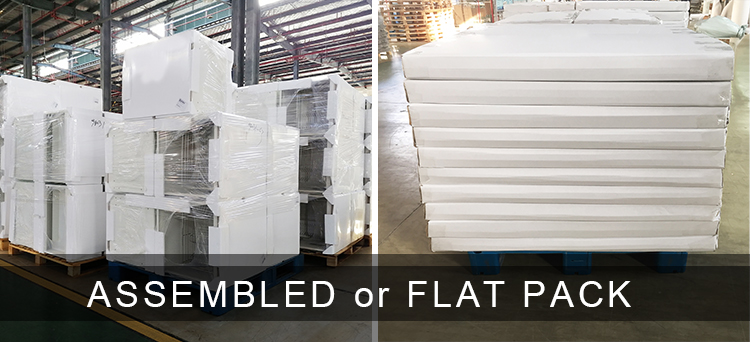
| Method | What is packed | Advantages | Points to check | Suitable for |
|---|---|---|---|---|
| Assembled | Cabinet carcases are assembled at the factory; doors, drawers or accessories may be protected separately. | Less site assembly, factory-controlled squareness and faster installation. | Uses more container volume and needs strong corner and movement protection. | Projects with limited installation labour or tight schedules. |
| KD / flat-pack | Panels and fittings are packed as labelled sets for assembly at destination. | Better loading efficiency and easier movement through narrow access. | Check drilling accuracy, hardware kits, instructions and installer capability. | Distributors and projects with trained local installers. |
| Mixed | Simple units are flat-packed; complex drawer, pull-out or lift-system cabinets remain assembled. | Balances freight efficiency with lower installation risk. | Every package must be clearly linked to its cabinet and room. | Large projects with repeated kitchens and complex functional cabinets. |
Assembled
What is packed
Factory-assembled carcases; doors, drawers or accessories may be protected separately.
Advantages
Less site assembly and faster installation.
Check
Higher container volume and stronger corner and movement protection.
KD / flat-pack
What is packed
Panels and fittings packed as labelled sets.
Advantages
Better loading efficiency and easier access handling.
Check
Drilling accuracy, hardware kits, instructions and installer capability.
Mixed
What is packed
Simple units flat-packed; complex functional cabinets assembled.
Advantages
Balances freight efficiency and installation risk.
Check
Clear package-to-cabinet and room identification.
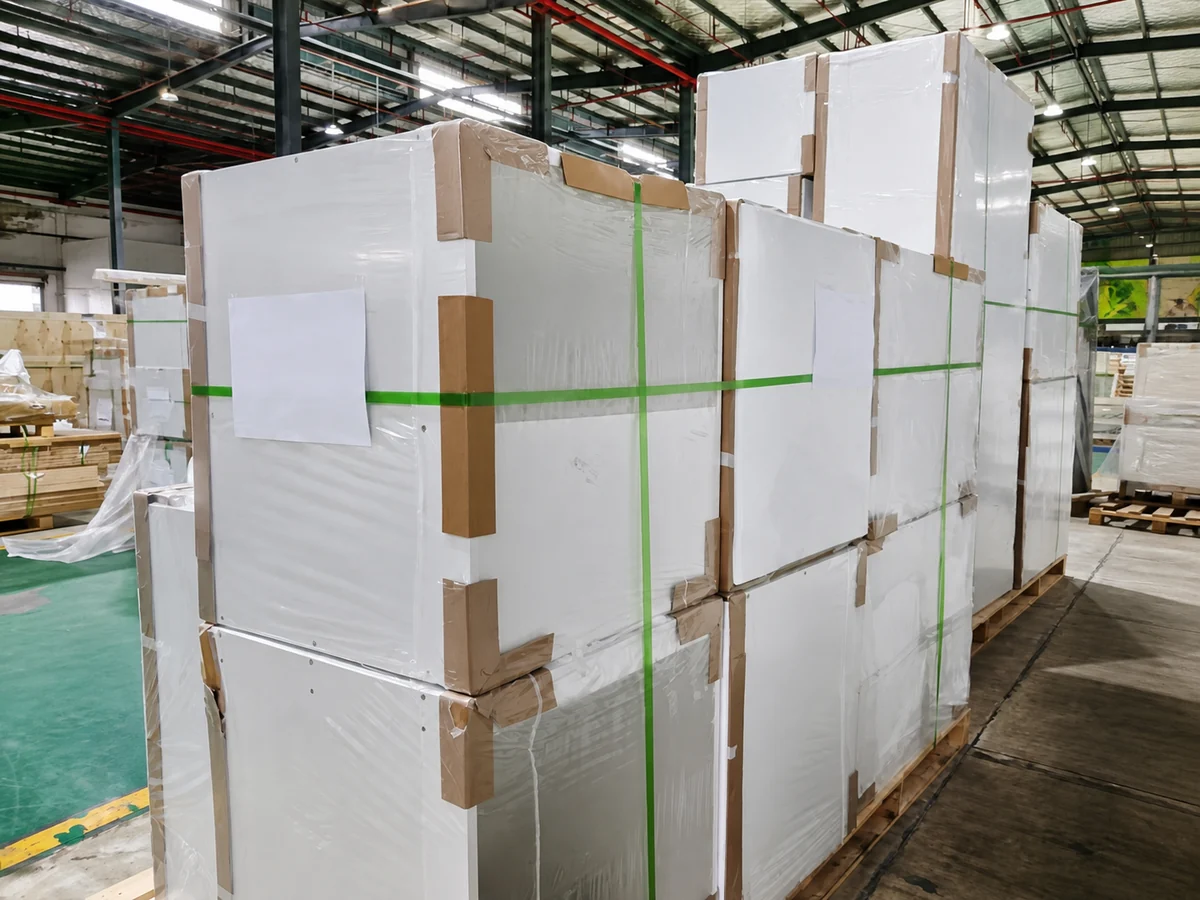
Build protection in layers
The material combination should match the surface, weight and handling risk. One standard carton is not enough for every cabinet component.
Pack separately when necessary: glass, mirrors, stone, sinks, handles and long decorative panels require their own protection and handling marks.
Select the pallet from the receiving conditions
Solid wood export pallets: when the destination applies ISPM 15, the pallet must carry a clear, valid IPPC treatment mark with the country code, producer or treatment-provider code, and treatment code. This is commonly called a “fumigation mark,” although the treatment may be HT (heat treatment) rather than MB fumigation. Do not accept an unmarked solid wood pallet.
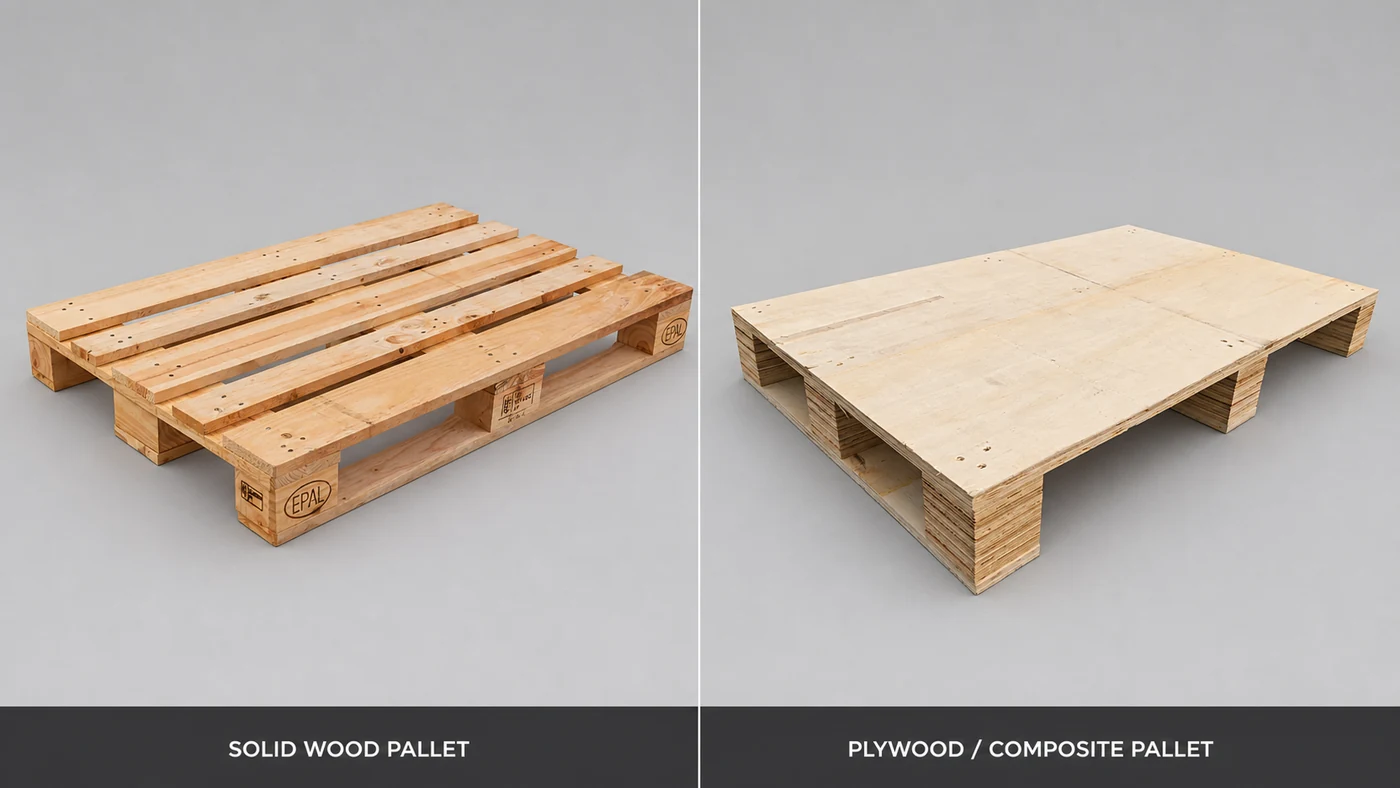
| Option | When to use | Important checks |
|---|---|---|
| Solid wood pallet | Common for heavy export loads and mechanical handling. | Confirm load rating, pallet condition and the applicable valid IPPC / ISPM 15 treatment mark. |
| Plywood / processed-wood pallet | Useful where processed material, lower weight or destination requirements make it suitable. | Confirm construction strength and whether the destination accepts the selected material. |
| No pallet / floor-loaded | When maximum container utilisation is important and manual unloading is available. | More individual handling, slower unloading and greater sorting and damage risk. |
Solid wood pallet
Use
Heavy export loads and mechanical handling.
Check
Load rating, condition and the applicable valid IPPC / ISPM 15 treatment mark.
Plywood / processed-wood pallet
Use
When lower weight, processed material or destination rules make it suitable.
Check
Construction strength and destination acceptance.
No pallet / floor-loaded
Use
When container utilisation is critical and manual unloading is available.
Check
More handling, slower unloading and greater sorting and damage risk.
Before approval: verify pallet footprint, loaded height, total weight, forklift entry direction, container fit, warehouse racks and site unloading equipment.
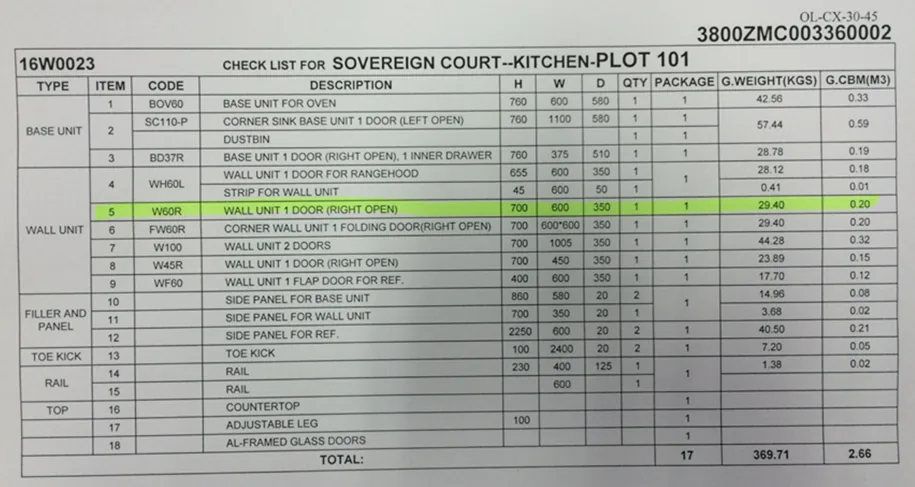
Make every package identifiable without opening it
The shipping mark should connect the factory order, transport documents and the buyer's receiving plan. Use one approved format throughout the shipment.
Approve before mass packing: one sample label, one sample carton and the final packing-list format. Repeat critical marks on at least two visible sides where practical.
Learn More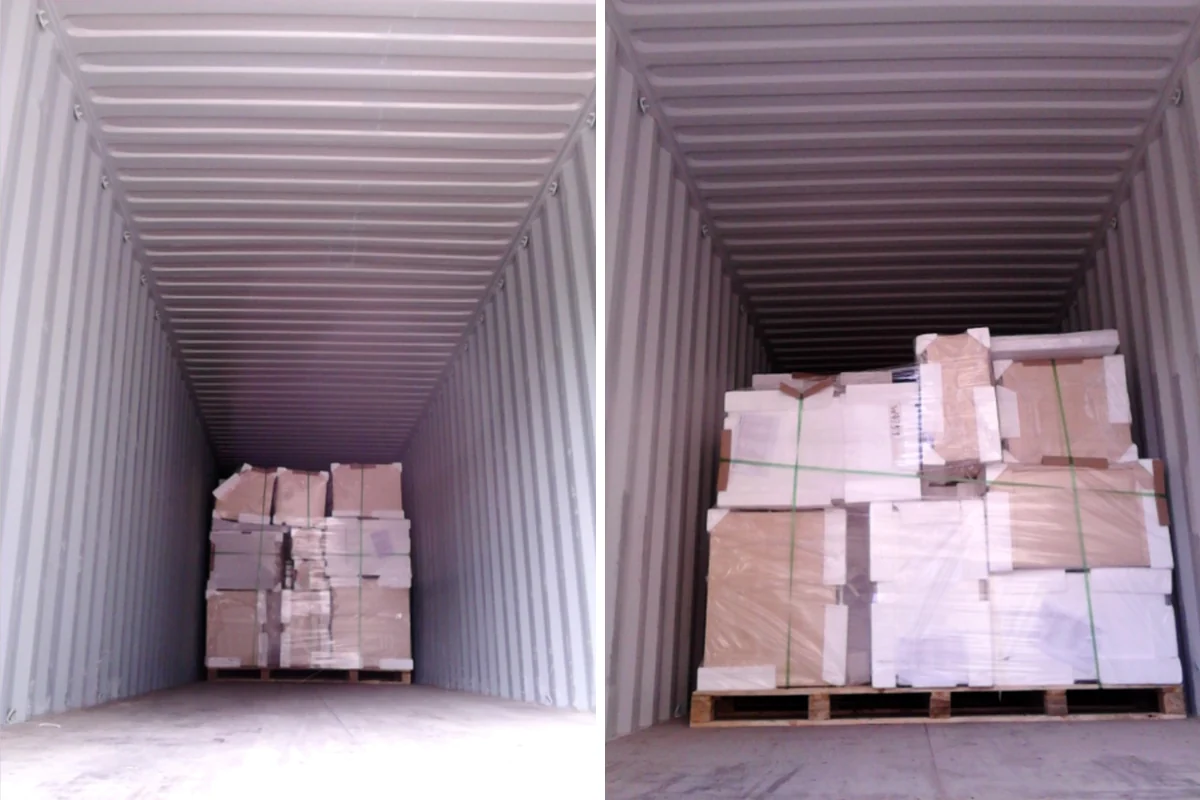
2. Container selection
Standard dry containers are normally suitable for packaged cabinetry. The figures below are typical reference values, not booking guarantees: dimensions, door openings, tare weight and payload vary by carrier and individual container.
| Container | Approx. internal dimensions (L × W × H) | Nominal volume | Typical cabinet use |
|---|---|---|---|
| 20' GP | 5.90 × 2.35 × 2.39 m | About 33 m³ | Small orders, heavy cargo or destinations where a smaller delivery batch is easier to receive |
| 40' GP | 12.03 × 2.35 × 2.39 m | About 67 m³ | Medium-to-large orders without high packages |
| 40' HC / HQ | 12.03 × 2.35 × 2.70 m | About 76 m³ | Common for volume-sensitive cabinet and furniture shipments |
Nominal volume is not actual loading capacity. Carton dimensions, pallet footprint, door opening, non-stackable items, weight distribution, safety gaps, bracing and unloading sequence all reduce usable space. Ask the supplier for a package list and preliminary loading plan—not only a total CBM.
What are LCL and FCL?
| Mode | Meaning | Advantages | Points to check |
|---|---|---|---|
| LCL Less than Container Load | Your cargo shares a consolidated container with shipments from other businesses. Charges are generally based on volume or chargeable weight. | Suitable for smaller orders; no need to pay for a whole container. | More consolidation/deconsolidation handling, potentially longer transit, extra warehouse charges and higher packaging demands. |
| FCL Full Container Load | One shipper's goods occupy the container under one FCL shipment. The container does not have to be physically full. | Less cargo handling, easier sealing and loading control, often better for larger or fragile project orders. | You pay at container level; compare utilisation, total route cost, free time and site unloading capacity. |
There is no universal CBM at which FCL becomes cheaper. Compare complete LCL and FCL quotations for the same cargo-ready date, route and service scope.
3. Freight prices and trade terms
Ocean freight changes with route demand, vessel space, equipment availability, fuel, peak seasons, port conditions and temporary surcharges. A price comparison is only meaningful when both quotations include the same origin, destination, cargo-ready date, container type, free time and local-charge scope.
How early should you request a freight quotation?
For budgeting, obtain an indicative estimate four to eight weeks before cargo is ready. For an actionable quotation and booking, two to four weeks is a practical working window on many routes; reconfirm the rate, sailing, space and equipment when booking and again before loading. During peak periods, constrained routes or the weeks around Chinese New Year, begin four to six weeks or more in advance.
There is no fixed number of days that guarantees accuracy. Carrier quotations have their own valid-from and valid-to dates; some spot offers are valid only for hours and for a specific sailing. The quotation's written validity and booking confirmation—not the date it was requested—control whether the price can be relied on.
What do EXW, FCA, FOB and CIF mean?
| Term | Seller's main responsibility | Buyer should understand |
|---|---|---|
| EXW Ex Works | Makes the goods available at the named premises. | Buyer normally arranges loading, export procedures and transport. ICC guidance notes that EXW is primarily suited to domestic trade. |
| FCA Free Carrier | Delivers the goods to the buyer's nominated carrier at the named place and clears them for export. | Often the technically suitable Incoterm for containerised or multimodal shipments delivered to a terminal or carrier. |
| FOB Free on Board | Loads the goods on board the nominated vessel at the named port of shipment. | Risk transfers when goods are on board. FOB remains common in quotations, but the named port and exact scope must be written clearly. |
| CIF Cost, Insurance and Freight | Pays cost, ocean freight and minimum insurance to the named destination port. | Freight being prepaid does not mean risk stays with the seller until arrival: under CIF, risk transfers when goods are on board at origin. Destination charges, import clearance, duties and final delivery are normally not included. |
Compare landed cost, not only ocean freight. Check factory pickup, origin handling, export clearance, terminal fees, ocean freight, surcharges, destination handling, customs brokerage, duties/taxes, delivery, storage, demurrage and detention.

4. What should the supplier provide?
Quality and shipment evidence
- Approved drawings, specifications, colour and material schedule.
- Production and pre-packing photographs for agreed checkpoints.
- Inspection report or buyer-appointed third-party report, when required.
- Packing photographs, package count, weights, dimensions and total CBM.
- Container condition and loading photographs, container number and seal number.
- Material, hardware or test certificates specifically required by the contract or destination.
Commercial and customs documents
- Commercial invoice and detailed packing list.
- Bill of lading draft for buyer approval, then the agreed final B/L or sea waybill.
- Sales contract or purchase order references and export declaration data.
- Certificate of origin, insurance certificate under CIF, and wood-packaging or treatment information when applicable.
- Any destination-specific licence, conformity document or certificate agreed before production.
Responsibility must be agreed in writing. The importer and customs broker should confirm the HS classification, import permits, taxes, product rules and exact document set for the destination. Under L/C, D/P or other documentary payment methods, document wording, dates and presentation requirements must also match the contract and banking instructions.
5. Other shipping considerations
- Moisture: load only into a clean, dry container; select desiccants and moisture protection for the route, season and product.
- Cargo security: control voids, weight distribution, blocking, bracing and restraint; record the seal after loading.
- Insurance: confirm insured value, coverage, exclusions, deductible, claim deadline and evidence requirements.
- Free time: understand demurrage, detention and storage rules before arrival.
- Destination access: check truck restrictions, unloading labour, forklift capacity, lift sizes and temporary storage.
- Delivery sequence: load according to the receiving and installation programme, not only factory completion order.
- Document accuracy: approve consignee, notify party, ports, package count, weight and cargo description before the B/L cut-off.
- Contingency: allow for port congestion, rollover, customs inspection, public holidays and project-site delays.
Final pre-shipment control: do not release the shipment until the buyer has approved the inspection result, packing list, shipping marks, container plan, quotation scope and draft transport document.
Buyer checklist before booking
- Confirm cargo-ready date, destination and delivery address.
- Approve assembled, KD or mixed packaging and package marks.
- Obtain dimensions, gross weight, package count and preliminary loading plan.
- Compare LCL and FCL on total landed cost and handling risk.
- Choose the Incoterm and write the exact named place or port.
- Check quotation validity, sailing, transit time, free time and excluded charges.
- Approve inspection evidence and all draft shipping documents.
- Confirm unloading equipment, storage space and installation sequence.
Need help shipping products from China?
Tell IanProject the product type, quantity, destination, cargo-ready date, packing requirements and preferred trade term. We can help match a suitable factory, coordinate quality and packing evidence, and prepare a clearer shipping plan for your project.
References
Cabinet packaging, pallet handling, room identification and loading photographs were drawn from IanProject's supplied OULIN export packaging training material. Container identification and terminology were cross-checked against the supplied container reference documents.
External references: Maersk container types and sizes; Maersk LCL guidance; Hapag-Lloyd quotation validity; ICC Incoterms rules; IPPC ISPM 15; UNECE CTU Code; and U.S. CBP formal-entry document example.
Container dimensions are approximate and vary by equipment. Customs and documentary requirements vary by destination, product and payment arrangement; confirm them with the carrier, importer, customs broker and bank before shipment.